Hole 4 · Since 1860
Tweed golf jackets: the Norfolk jacket on the links
1860s onward
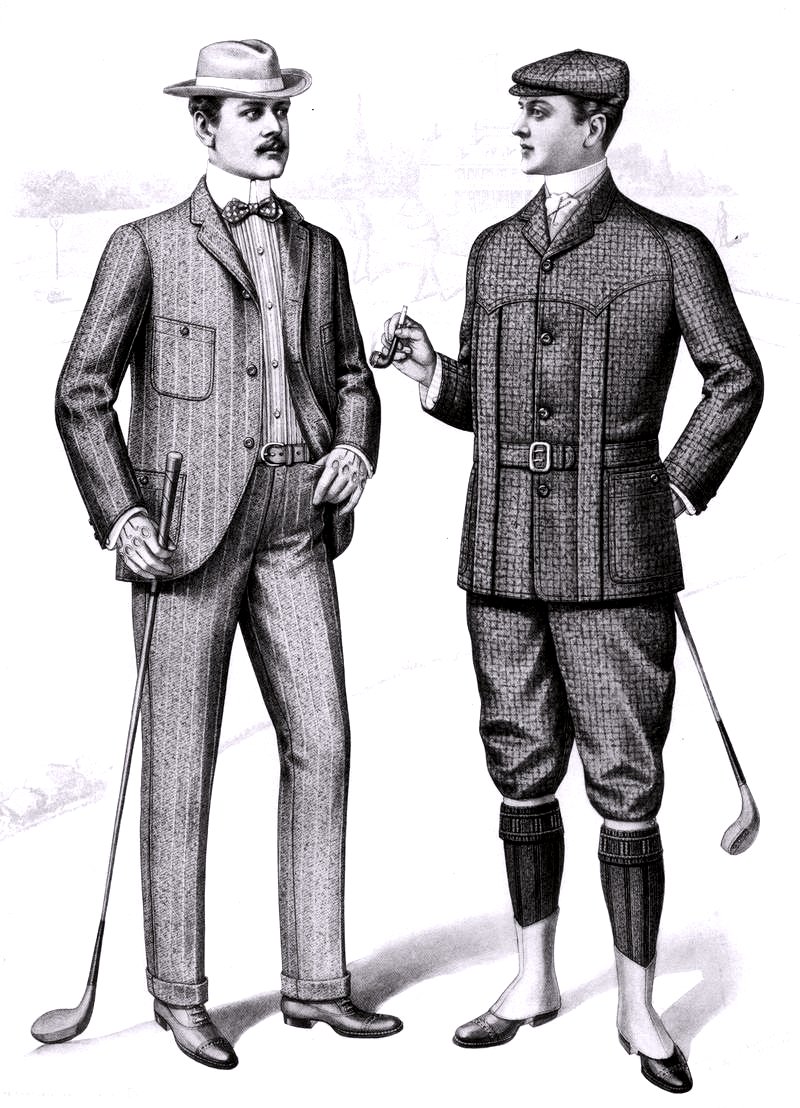
The tweed golf jacket grew out of the Norfolk jacket. Golfers wore it from the 1860s, usually in tweed or heavy Shetland wool, and its pleats gave the arms room to swing. The tweed look lasted in golf until the 1930s. Today a tweed jacket turns up in the clubhouse rather than on the tee.

What it solved on the course
Tweed gave golfers a jacket that was moisture-resistant, durable and warm, and allowed a greater range of movement when swinging a golf club. The Norfolk's pleats allowed a greater range of movement when lifting the arms or swinging a golf club.
History
The tweed golf jacket grew out of the Norfolk jacket. A widespread theory says Henry Fitzalan-Howard, the 15th Duke of Norfolk, invented it as a hunting coat in the 1860s. According to that theory, the Prince of Wales, later Edward VII, popularized it in the 1880s. In the 1930s many thought the Norfolk was cut slightly roomier than a sportscoat, with an all-around belt and two long box pleats in front and one down the back; the version many call the most classic had a single-breasted front with three or four buttons, pleats and a full belt. Those pleats let a man lift his arms to swing a club, and the belt cinched the waist. The cloth was usually tweed or heavy Shetland wool, with Harris tweed and homespun among the first choices. Tweed is a rough woolen cloth, usually woven plain, twill or herringbone. It resists moisture and wears hard, which suited the rainy, chilly British climate. In the Hebrides, Harris Tweed became golf's uniform when the game arrived in the 1890s; a course appeared near Stornoway in 1890, and Old Tom Morris laid out Askernish on South Uist in 1891. The look held in golf until the 1930s. After the war, cotton and specialist fabrics came into golfing attire. Tweeds vanished as functional golf clothing, though a Norfolk jacket or sport coat still turned up in clubhouses. The Ryder Cup at Gleneagles in 2014 brought Harris Tweed back as official cloth, swatch RC24, a herringbone in a new blue yarn.
Who wore it best
Henry Fitzalan-Howard, 15th Duke of Norfolk
A widespread theory credits him with inventing the Norfolk jacket as a hunting coat in the 1860s. That jacket, with its pleats and belt, became the tweed golf jacket.[1, 6]
Edward VII
As Prince of Wales he popularized the Norfolk jacket in the 1880s. Later as king he was credited with the Norfolk jacket becoming part of the gentleman's wardrobe.[1, 5]
How to wear it now
- Wear it as a light outer layer over an oxford shirt and a thin merino sweater or jumper. Leave the belt loose or buckled at the side.
- For a winter round, pick a heavier tweed with a roomy cut. You need to swing, not pose. Add a quilted vest if the wind is up.
- Keep the rest quiet: gray flannel trousers, a plain oxford shirt, and brown leather shoes. Black shoes can look too sharp with most tweeds.
- For the clubhouse, wear it open over a polo or a button-down. A wool or silk tie is fine if the room calls for it.
- At heritage events, a Norfolk with pleats and belt is the point. Let the jacket be the period piece and avoid slim modern trousers.
Where to buy
New
Vintage
Links open the shop's own site. Some may earn us a commission.
Sources
- Gentleman's Gazette, Gentleman's Gazette. Retrieved 2026-10-01.
- Harris Tweed Hebrides, Harris Tweed Hebrides. Retrieved 2026-10-01.
- Wikipedia, Wikipedia. Retrieved 2026-10-01.
- Well Dressed Dad, Well Dressed Dad. Retrieved 2026-10-01.
- Tweed Room, Tweed Room. Retrieved 2026-10-01.
- De Oost Bespoke, De Oost Bespoke. Retrieved 2026-10-01.
- Westwood Hart, Westwood Hart. Retrieved 2026-10-01.
Updated .