Hole 9 · Since 1920
The golf sweater (or jumper): argyle, V-necks and the sweater vest
1920s to today
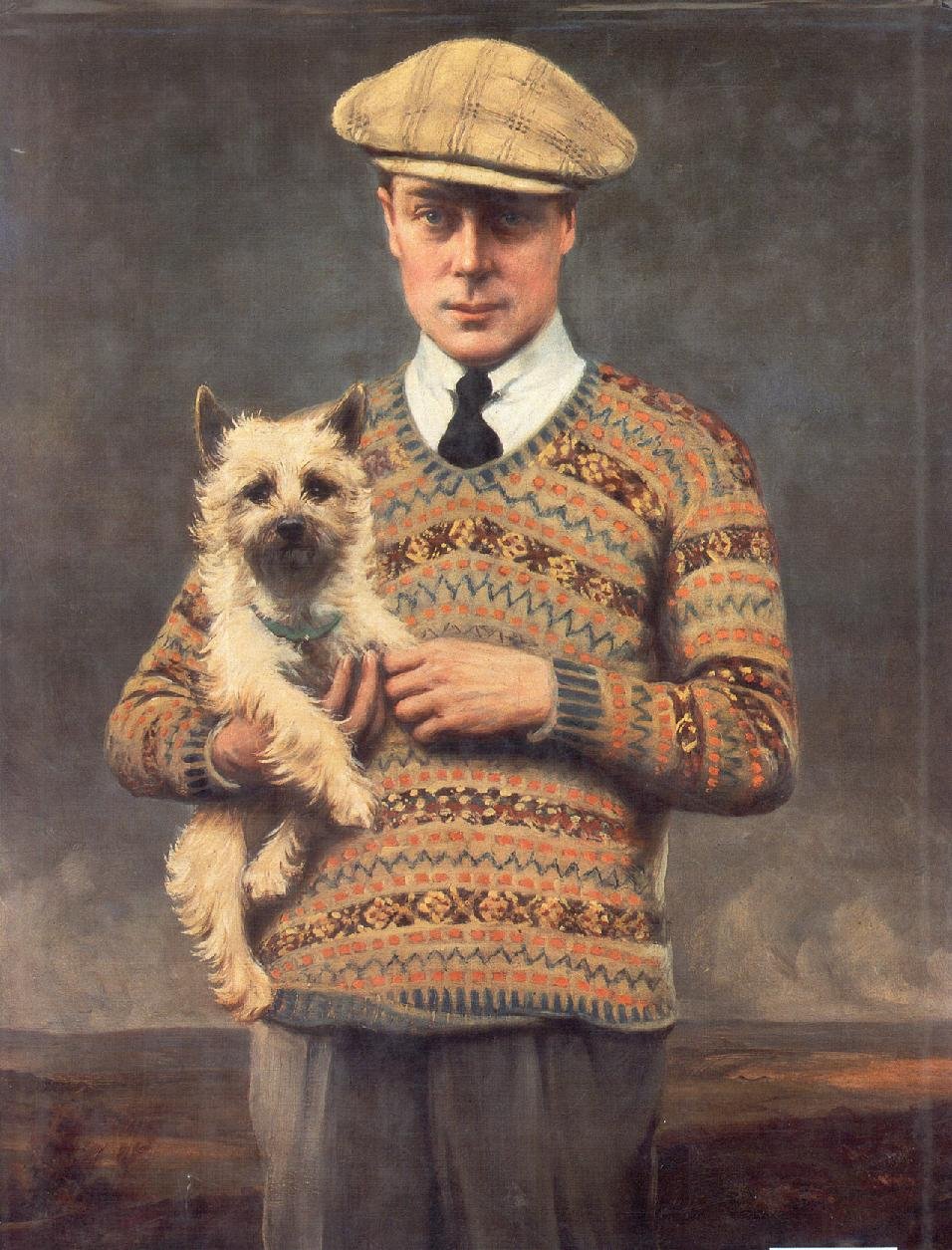
The golf sweater arrived from Scotland: argyle diamonds drawn from Clan Campbell tartan, popularized by Pringle of Scotland and the Duke of Windsor. The V-neck and the sleeveless vest kept golfers warm and their swings free, and Payne Stewart made the pattern his own.

What it solved on the course
A knitted layer for cold mornings that keeps the chest warm while leaving the arms free to swing. A sweater vest sits neatly over a polo without adding bulk at the shoulders, and the argyle pattern carries club and clan color.
History
The argyle pattern takes its name from Argyll, the Scottish heartland of Clan Campbell. Its diamonds echo the clan tartan and the "tartan hose" that Scottish Highlanders wore from at least the 17th century. Argyle knitwear crossed into fashion in Britain and then America after the First World War. Pringle of Scotland, founded by Robert Pringle in 1815 in the Scottish Borders and based in Hawick, did much of the popularizing, helped by the Duke of Windsor (the same man who, as Prince of Wales, took plus fours to America), who used the pattern on golf jerseys and the long socks that went with plus fours. Pringle's own site dates its argyle design to the 1920s. Otto Weisz, the knitwear industry's first full-time designer from 1934, worked on the twinset and an adapted argyle, worn later by Jean Simmons, Brigitte Bardot and Grace Kelly. Through the 1980s and 1990s Pringle sponsored British tour players Nick Faldo and Colin Montgomerie. On the course, the sweater vest, a tank top or slipover in Britain, did the quiet work: a low-cut, sleeveless knit that kept the chest warm and left the arms free. It was popular in the 20th century, especially in 1970s Britain, and is growing again now. Payne Stewart, winner of the U.S. Open in 1991 and 1999 and the PGA Championship in 1989, made argyle socks part of a look that also included flashy tams and knickerbockers.
Who wore it best
The Duke of Windsor
Used the argyle pattern on the course, on golf jerseys and the long socks that went with plus fours.[1]
Payne Stewart
Known for flashy tams, knickerbockers and argyle socks; won the U.S. Open in 1991 and 1999 and the PGA Championship in 1989.[1]
Nick Faldo
One of the leading British tour players sponsored by Pringle of Scotland through the 1980s and 1990s.[2]
Colin Montgomerie
A leading British tour player sponsored by Pringle of Scotland through the 1980s and 1990s.[2]
How to wear it now
- Wear a fine-gauge V-neck over a polo with the collar out, and let the argyle do the talking. Keep everything else plain: navy or gray trousers, a leather belt, a clean shoe.
- For the vest, size it to sit close over a collared shirt without pulling across the chest. A sleeveless knit is a lighter answer than a full sweater in autumn and still leaves the swing free.
- If the diamonds feel loud, choose a single-colour knit with contrast trim at the neck and cuffs, or a small-scale argyle in muted colors.
- On cold mornings, layer a merino V-neck under a quilted vest or a half-zip, then take the sweater off as the day warms.
Where to buy
New
Vintage
Links open the shop's own site. Some may earn us a commission.
Sources
- Argyle (pattern), Wikipedia. Retrieved 2026-09-29.
- Pringle of Scotland, Wikipedia. Retrieved 2026-09-29.
- Sweater vest, Wikipedia. Retrieved 2026-09-29.
Updated .