Hole 5 · Since 1900
Golf headcovers: how they protect clubs and show some personality
20th century to today
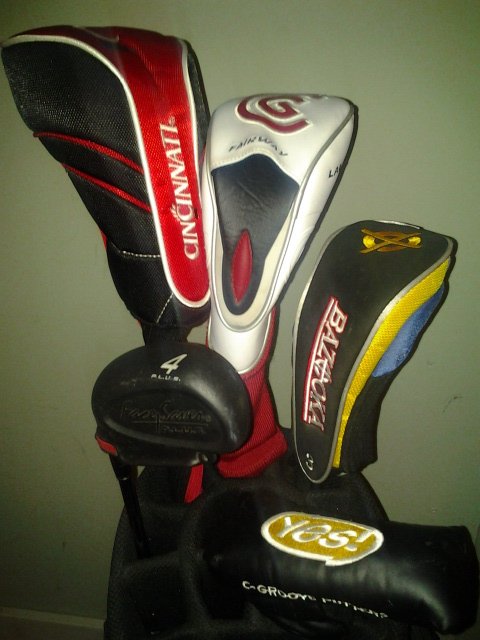
Golf headcovers protect your most expensive clubs from knocks, sun and wear. They started as old wool socks in the early 1900s, and they are now the most personal thing in the bag. The most famous is Tiger Woods' tiger, a gift from his mother.

What it solved on the course
A headcover stops clubs knocking against each other in the bag and keeps the sun off the finish, which matters most on a driver. Fleece linings and elastic bands keep it on. It has also become the easiest way to put some personality, or a maker's logo, on the bag.
History
Headcovers are younger than they look. The earliest record of one dates to the early 1900s, when shafts were hickory and the shorter clubs dinged and weakened the longer ones in the bag. Players pulled their old winter socks over the heads, and the sock shape is still the base of many covers today.
You will struggle to find a photo of one before the Second World War, though. Walter Hagen, Henry Cotton and Bobby Jones all played without them. By the 1950s they were in the best bags: Sam Snead had covers on when he beat Ben Hogan by one stroke in their playoff for the 1954 Masters. Gary Player had them in 1961, when he became the first international Masters champion, and Jack Nicklaus kept his MacGregor woods covered through the 1970s.
In the 1980s a new club rarely came with a cover worth using, and most were sold by third parties. Then manufacturers saw the space for a logo, and by 2000 a cover came with almost every driver, fairway wood, hybrid and putter.
The cover as personality has one famous root. Tiger Woods had carried a Daphne's tiger cover for a few years when, on April 13, 1997, he won the Masters by 12 strokes at 21. His mother, Tida, gave him a new one every year with Rak jak Mea (Thai for "Love from Mom") sewn on the back, and tucked a note of his year's achievements inside. Ernie Els' lion and Padraig Harrington's ladybug followed the tiger onto Tour.
Who wore it best
Tiger Woods
Has carried a Daphne's tiger cover, known as Frank, since before his 1997 Masters win. His mother gave him a new one each year.[1, 4]
Sam Snead
Had covers on his woods when he beat Ben Hogan in the playoff for the 1954 Masters, when most bags still went without.[4, 6]
Gary Player
Carried covers in 1961, the year he became the first international champion at the Masters.[4, 5]
Jack Nicklaus
Kept his MacGregor woods covered through the 1970s, long before covers came free with clubs.[4]
How to use it now
- Choose one animal or novelty cover as the focal point of your bag, then keep the rest simple.
- Match a knitted wool cover to your bag's colors for a classic, textured look.
- For leather covers, wipe them clean after wet rounds and condition them once a season.
- If you like a tidy bag, stick to one material family (all leather or all knit) rather than mixing everything.
Where to buy
New
Vintage
Links open the shop's own site. Some may earn us a commission.
Sources
- Let's be Frank: The inside story behind Tiger Woods' famous headcover, GOLF.com. Retrieved 2026-09-29.
- Best golf headcovers: protect your clubs in style, GOLF.com. Retrieved 2026-09-29.
- 5 golf driver headcovers with big personality, GOLF.com. Retrieved 2026-09-29.
- One hundred years in head-covers, David Alexander Golf. Retrieved 2026-09-29.
- 1961 Masters Tournament, Wikipedia. Retrieved 2026-09-29.
- 1954 Masters Tournament, Wikipedia. Retrieved 2026-09-29.
Updated .